An AI system’s memory breaks not only when it forgets something. More often, it breaks when it starts remembering everything indiscriminately — without structure, priorities, or rules of canonicity.
In the previous installments of this series, I wrote about architecture, the trust pipeline, agent composition, the public template, and retrieval under benchmark pressure. But beneath all these layers lies another one — less spectacular, yet fundamental. It is memory architecture.
When a system is small, it almost always seems like a few memory files, a folder of notes, and semantic search are enough. Over a short horizon, that suffices. Over a long one, something else begins: artifacts grow to hundreds, links to thousands, the same truth lives in multiple places, retrieval returns what is plausible but non-canonical, and memory slowly transforms from a foundation into a source of noise.
It is precisely at this point that Ayona/OpenClaw transitioned into a new state over recent days. Not from “memory appeared” to “memory works,” but from a set of useful memory carriers to a more governed, graph-first memory architecture. In the logic of this entire series, this is no longer a text about agent composition or a benchmark article about retrieval. It is a distinct next step: memory governance as a load-bearing structure of the entire system.
The Problem: AI Memory Degrades in Two Ways
In a poorly organized AI system, memory degrades along two symmetric paths.
The first, obvious one, is short memory. The system perpetually lives within the current session, forgets prior decisions, repeats conclusions already reached, sees no continuity between tasks. This is the typical weakness of almost any chatbot.
The second, less obvious but no less dangerous, is amorphous memory. When we try to solve the forgetting problem, we start accumulating everything: daily logs, summaries, process notes, memory markers, task snapshots, architecture notes, debug traces, personal agreements, incidents, stable invariants, stray ideas. At some point the system seemingly “has a lot of memory,” but in practice loses determinism. The same thing can exist in five places. Retrieval begins returning what is plausible but non-canonical. Memory becomes not a foundation, but a source of drift.
This is an important lesson: memory without a semantic contract almost inevitably becomes noise.
From Memory Dump to Semantic Contract
The key shift in Ayona/OpenClaw did not happen when another memory file appeared. It happened when memory began being described not merely as a collection of carriers, but as a system of layers with clear roles.
The semantic contract looks like this:
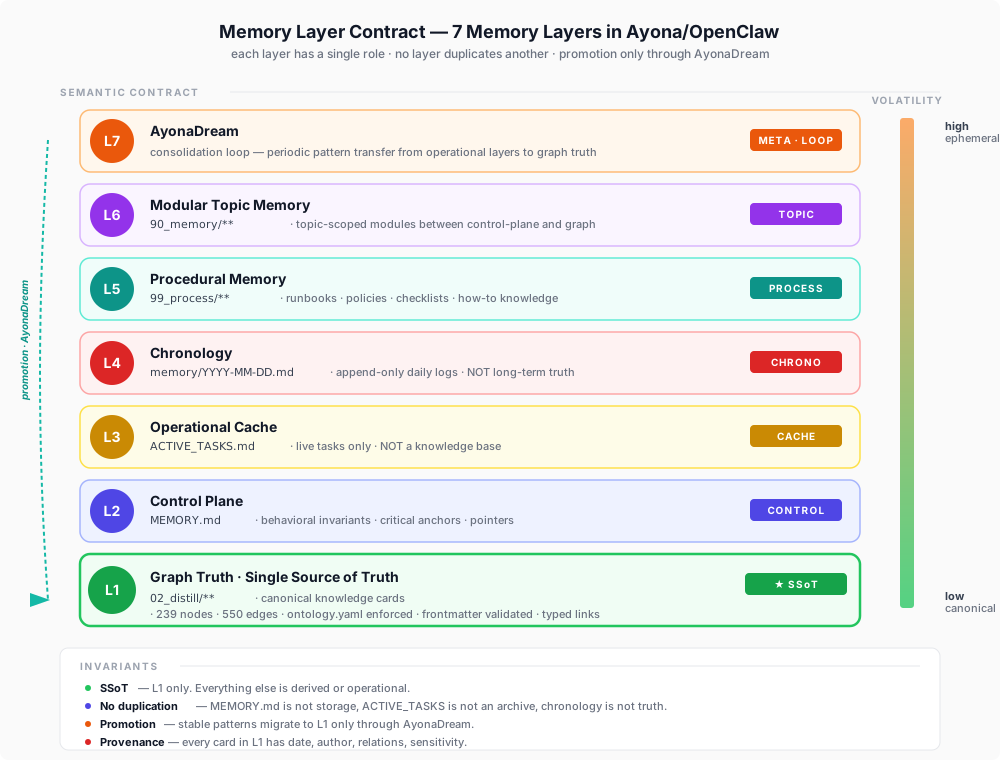 Fig. 1. Semantic contract of 7 memory layers: from graph truth (SSoT) to AyonaDream consolidation.
02_distill/**— graph truth, the canonical home for reusable knowledge, architectural decisions, structured insights, and linked cards.MEMORY.md— control plane, not a warehouse. This is where behavioral invariants, critical infrastructure anchors, stable human agreements, and pointers to deeper layers live.ACTIVE_TASKS.md— operational cache for live tasks, not another knowledge base.memory/YYYY-MM-DD.md— chronology, not long-term truth.99_process/**— procedural memory: runbooks, incident documents, policies, checklists.90_memory/**— modular topical memory between the short control plane and the large graph/process circuit.- AyonaDream — a consolidation loop that periodically reviews accumulated context and promotes stable patterns from operational layers into graph truth.
On paper, this sounds simple. But its power lies not in the simplicity of formulation, but in the fact that it forbids mixing roles. MEMORY.md no longer has the right to slowly morph into an archive. Daily logs must not masquerade as canonical memory. ACTIVE_TASKS.md must not become a graveyard of closed tasks. Process documents must not duplicate the memory index. This is precisely what architectural maturation means: not simply more files, but less semantic ambiguity.
Graph-First Memory: Why the Graph Became the Core, Not a Side Artifact
Previously, a knowledge graph in such systems often remained something decorative. A nice visualization, interesting links, another way to view content. But in a mature AI system, the graph layer must not be optional. It must be the topology of memory.
In Ayona/OpenClaw’s current architecture, the graph is the place that stores what has reuse value and relation value: knowledge, decisions, concepts, tasks, cross-cluster links. This matters for two reasons.
First, the graph allows answering not just “what do we know” but “how is it connected.” Flat memory cannot do this. It stores texts, but not topology.
Second, graph-first design gives retrieval a proper starting point. Instead of eagerly loading everything or blindly searching a large corpus semantically, the system can first narrow the relevant subspace and only then read specific artifacts. This reduces noise, conserves context, and makes reasoning less random.
This is why recent changes were aimed not merely at populating the graph with new nodes, but at strengthening it as a memory substrate.
What Actually Changed in the Latest Cycle
Over recent days, several changes occurred in Ayona/OpenClaw that are easy to underestimate when viewed individually. Together, they mean that memory in the system became not just larger, but more governed.
1. Canonical Taxonomy
The graph received a stricter canonical taxonomy, anchored in config/ontology.yaml as the single source of truth. 9 node types (knowledge, insight, task, project, direction, process, decision, person, longterm), 10 relation types, 10 clusters — all of this is now not a local habit, but an agreed-upon schema on which validators, scripts, and retrieval depend.
The architectural rationale is simple: in a knowledge system, drift almost always starts not with major catastrophes, but with small “I’ll just name this slightly differently here” moments. A month later, it is no longer a minor thing, but a new chaotic dialect within the same memory.
Canonical taxonomy does not make a system prettier. It makes it less fragile.
2. Typed Links Instead of Amorphous RELATED_TO
Another important change is the shift from overusing weak links to more typed relations. For a knowledge graph, this is critical. A bad graph is not one with few links. A bad graph is one where almost all links are semantically identical.
If everything is connected to everything via a generic RELATED_TO, the graph stops being a reasoning substrate and becomes merely a reference network. Typed relations restore its semantic structure: what follows from what, what validates what, what depends on what, what extends what, what is part of what.
In other words, the graph stops being a flat adjacency map and becomes closer to a model of how the system thinks.
3. Frontmatter Normalization and Wiki-Link Resolution
A markdown corpus almost always begins living its own life. Someone writes one link format, someone else another; here the frontmatter is tidy, there it isn’t; here a slug matches, there it has already drifted. If this is not leveled, retrieval appears to work on content, but in reality keeps snagging on technical inconsistencies.
Normalizing frontmatter and resolving wiki-links became a step toward making the knowledge corpus not only human-readable but also machine-legible. For an AI system, this is not a minor thing. It is the difference between “the system can somehow read these documents” and “the system can reliably lean on them as infrastructure.”
4. Materialized Links as a Bridge Between Markdown Truth and the Retrieval Layer
One of the most interesting shifts is extracting links from the declarative markdown level into the retrieval/database level through materializing frontmatter.related.
Before this, links existed primarily as part of markdown truth. That is already useful. But when the same links become accessible in the retrieval circuit as well, the system starts working better not just as a collection of texts, but as structured memory with accessible relation paths.
This matters because the future of such systems lies not in having a good graph and good search separately, but in having these two layers reinforce each other. I will go into more detail about this — including the roles of OpenClaw, Hermes, and GBrain — in the next installment.
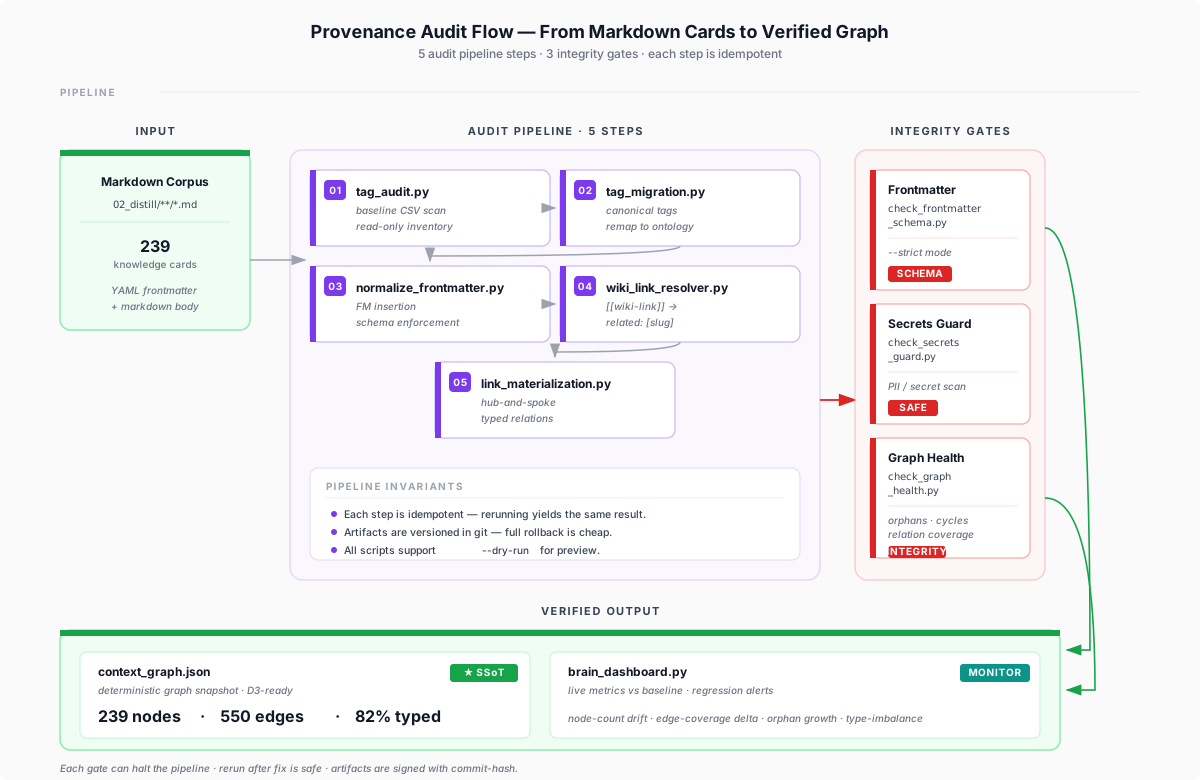 Fig. 2. Memory audit pipeline: from raw markdown corpus through 5 normalization stages to a verified graph.
5. Integrity Tests and Audit Tooling
Perhaps the least spectacular but one of the most important changes is the appearance of explicit memory integrity tests and an audit toolkit.
In practice, this means: memory now not only exists, but is verified. YAML/frontmatter parsing, canonical tags, related-slug validation, consistency rules, audit scripts, a dashboard, timeline extraction — all of this moves memory from the category of “useful corpus” into “maintained system with its own observability.”
For AI memory, this is a major threshold. Without it, memory is maintained through hope and manual attentiveness. With it — through engineering discipline.
6. Provenance as Part of the Trust Model
A separate but telling episode involved provenance mismatches between adaptation-related cards. Some cards lived with a date of 2026-04-12, others had already been normalized to 2026-04-16. Formally, this looked like a minor metadata issue. In reality, it was a violation of node identity consistency.
In a graph-first system, provenance is not cosmetics. When an ID, a timestamp, or a relation target diverge, what is damaged is not merely tidiness. What is damaged is trust that the graph is truly canonical. This is why canonicalizing provenance dates was not simply a cleanup operation, but yet another step toward memory governance.
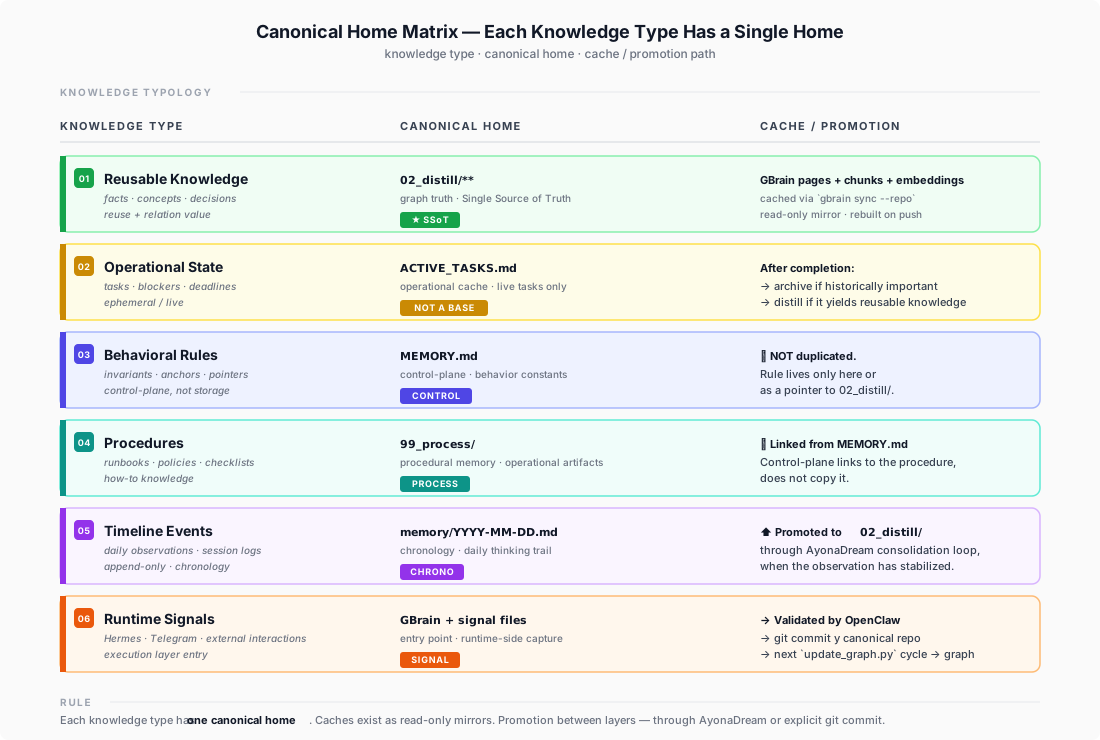 Fig. 3. Canonical Home Matrix: each knowledge type has a single canonical home, a defined cache, and promotion rules.
What I Deliberately Leave Out of This Installment
In this cycle, another major topic emerged that deserves its own text: full-fledged architectural interaction between OpenClaw, Hermes, and GBrain.
It is already present in the current system as a real architectural layer, but mixing it here with memory governance would pull the article in two different directions. So in this installment I deliberately keep the focus on memory: semantic contract, graph-first structure, canonicity, provenance, verification, and auditability.
I want to devote a separate next article to a different storyline: who in Ayona is the memory authority, who is the execution/runtime layer, how knowledge synchronization works, how the knowledge graph relates to the retrieval database, and why the dual-instance model proved stronger than the notion of “one universal agent.”
Why This Matters Beyond Internal Engineering
At this point it is easy to say: this is all internal plumbing. Why should a reader care about how memory substrate or frontmatter normalization are organized?
Because these are precisely the things that separate an AI system that speaks eloquently from an AI system that can be trusted with harder work.
When we say “the assistant remembers,” architecture must stand behind that claim: what exactly it remembers, where it lives, what is canonical, what is cache, what is merely chronology, how drift is detected, how links are verified, how retrieval distinguishes a stable rule from a stray note, how the system does not confuse an incident with an invariant.
Otherwise “memory” remains a marketing word.
Strong AI systems of the future will win not merely by having a larger context window or a higher reasoning benchmark. They will win because they can sustain a governed long-term cognitive structure without turning it into a landfill.
Three Lessons from This Stage
Lesson 1. Memory Should Be More Canonical, Not Bigger
The worst response to recall problems is simply accumulating more context. Usually this produces a short-term effect and long-term degradation. The right response is not just more memory, but a better semantic contract between its layers.
Lesson 2. A Knowledge Graph Only Makes Sense When It Is Verifiable
A graph alone does not save you. If relations are amorphous, taxonomy blurs, provenance is unsupported, and metadata drift passes unnoticed, the graph becomes decorative. Its power begins where there is a canonical schema, typed links, integrity tests, and audit tooling.
Lesson 3. Retrieval Starts Not with Embeddings, but with Sound Memory Architecture
You can deploy any good embedding model, but if the system does not know where its truth is, where its cache is, where chronology is, and where procedural memory is, retrieval will keep pulling half-truths. Search works only as well as the memory it runs over is organized.
What Remains Unfinished
It would be dishonest to say the architecture is complete at this stage.
There are at least three open risks.
The first is over-normalization. When many tools level a large corpus, there is always a risk that local meaning is inadvertently smoothed away along with the noise.
The second is duplication between top-level architecture documents and graph truth. Without discipline, a system document can begin living as a parallel source of truth instead of a synthesis overview layer.
The third is tooling outrunning ritual — the situation where engineering tools are already strong, but the operational ritual of using them is not yet stable enough. In such a phase, the system is technically capable of being disciplined, but is not always disciplined in practice.
This is not a reason to devalue what has been done. On the contrary. It is a sign that the system has moved from an early phase, where the main problem was “do we even have any architecture,” into a phase where the main question is different: how well does this architecture govern its own complexity.
Conclusion
When we talk about AI memory, it is easy to reduce it to a convenient metaphor: the assistant remembers what matters and becomes more useful. In practice, the question is harder. Not whether the system remembers, but how exactly it remembers, where truth lives, how drift is detected, and who controls canonicity.
The latest stage of Ayona/OpenClaw’s evolution showed me a simple thing: the memory of an AI system is not an add-on to architecture. It is one of its central load-bearing structures.
As long as memory remains a collection of files, the system only appears smart over a short horizon. When memory acquires a semantic contract, graph topology, provenance discipline, verification, and auditability, AI begins behaving not like a lucky chat, but like a system with a chance at long and reliable operation.
And perhaps this is where one of the key lessons of all AI-native engineering lies: it is not enough to build a model that thinks well. You must also build memory that thinks correctly over time.